

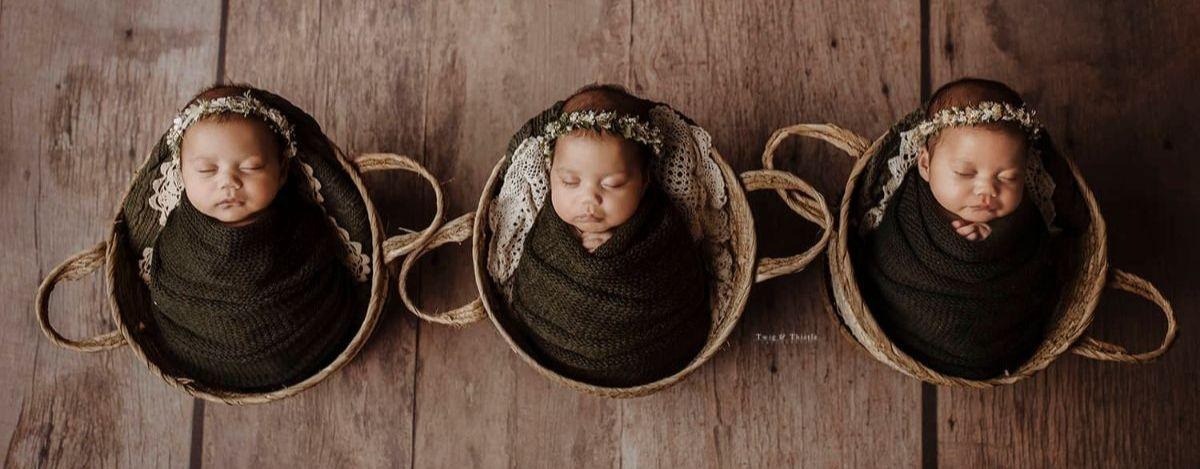
We’ve had a very rare and exciting arrival within our multiples club whānau.
Identical triplets Juanita, Kitty and Toni Broughton were born 13 weeks ago to Northland parents Paula and Joseph Broughton, who also have two older children, aged 9 and 10.
The chance of having identical triplets is estimated to be 1 in 200-million!
Mum Paula shared her story with our newsletter editor Natasha, who was blown away by Paula’s incredible positivity and strength throughout this new chapter in parenthood.
1. A huge congratulations to you and your family Paula. How’s it all going?
It’s actually really good, they eat, sleep and poo! Their eyes are wide open, they’re smiling and cooing. I’m really enjoying it, even when I’m on my own. I’ve had quite a few days and nights by myself while my husband’s been at work and I’m feeling good.
2. Wow, that’s so nice to hear! So you’re not too sleep deprived?
I feel like I’m getting a decent amount of sleep, they go down around 8pm, wake up about midnight, they’re up until about 2am and then they’re up again at 6am. I will put them on their feeding pillows and kind of cross feed them with the bottles and watch them all. Then I’ll hold onto the first two who are finished, burp them, wrap them up, change nappies and then do the last baby. We’ve got a good routine going on.
3. What was your reaction when you found out you were having triplets?
We found out at the 12 week scan, and I felt total despair, I’m not going to lie. My husband had this smirk on his face like ‘I just made triplets!’, but I was just crying in despair because we had decided to have one more child before my husband turned 40. After I caught my breath, the sonographer said to me “Alright Paula, now we have to take a look in the back to make sure there’s no more because there can be some hiding!” I am thankful there were only three!!
4. Identical triplets are so rare, what was your pregnancy journey like?
Our triplets were sharing one sac and one placenta. At a 16-week scan at Auckland Hospital, they said they hadn’t seen a pregnancy like this in something like 20 years. They told me it was a 1 in 200 million pregnancy and very high risk. They knew next to nothing about it because they hadn’t had one in such a long time, and said it’d probably be another 30 years before they have another. We walked away from there with absolutely no hope of the babies even getting to the next scan and appointment.
5. How did you manage the stress of that pregnancy?
I decided at 20 weeks to stop worrying. I am a teacher aid myself and I work with special needs children, and in the end I thought, I need to stop worrying and decided what will be will be, whatever happens we need to just relax and enjoy the pregnancy. I was actually really well from about 13 weeks when my morning sickness ended. They told me once I got to 26 weeks, the babies would be viable, so that’s when all worry left.
6. When were the girls born?
I made it to 32+4 because in the last two weeks my blood pressure started to rise and they said it was the placenta – it was huge and sucking everything out of me. They didn’t know what belonged to who anymore and they couldn’t monitor them properly so they decided to deliver the babies. They spent almost 6 weeks in SCBU, the nurses were amazing. We really enjoyed our time there.
7. You’ve been a mum before, but did anything prepare you for three at once?
My daughter who is 9 years old has autism spectrum disorder, she’s very low functioning and I’ve learned through her to relax, not to sweat the small stuff and stop worrying. When I’m home with the triplets on my own and they’re crying, it doesn’t freak me out and I think that’s all because of having my daughter. That’s who prepared me for this journey.
8. What has surprised you the most about having multiples?
Just how much help there is! I’ve got all these packages showing up on my doorstep from people who have found out and they just want to help. It’s amazing.
Authored by Natasha Bull, August 2022